
In just a decade, birth rates fell sharply across countries as different as South Korea, Mexico, Poland, Senegal and Iran. Different cultures, different economies, different religions, same direction.
And some of the numbers are becoming hard to ignore. Mexico now has lower birth rates than the United States. In parts of southern Europe and East Asia, current generations are on track for one in five women never becoming mothers. Imagine a classroom with 30 girls where six never have children. The demographic maths changes surprisingly fast.
That is partly what makes this story so interesting. There probably isn’t one single explanation.
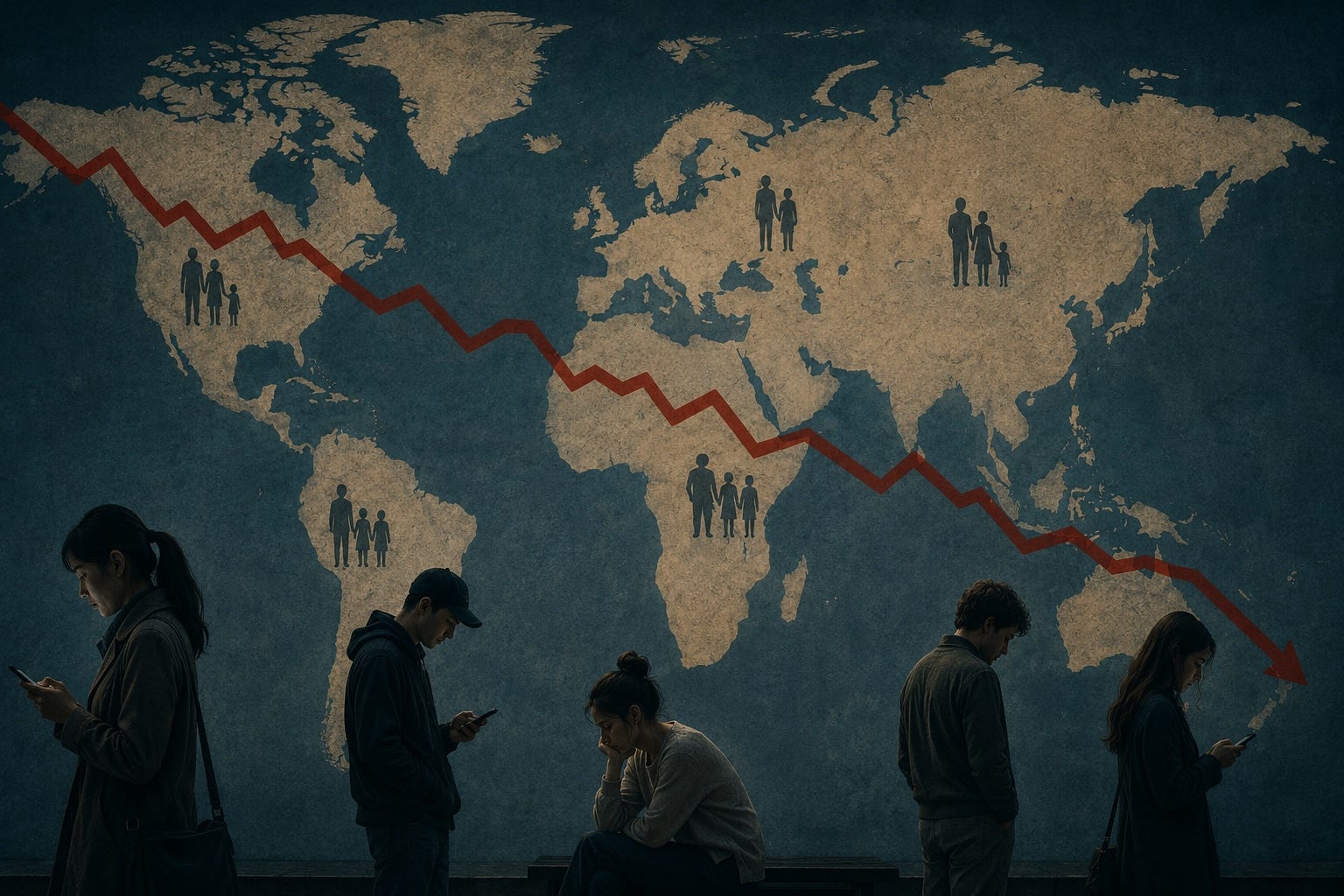
More than an economic story
Housing matters. Economic insecurity matters. Delayed adulthood matters. The cost of raising children matters. But the recent Financial Times piece by John Burn-Murdoch also explores another possibility becoming harder to dismiss: modern digital life may be accelerating deeper social changes already reshaping how humans form relationships and families. Financial Times piece
That nuance matters.
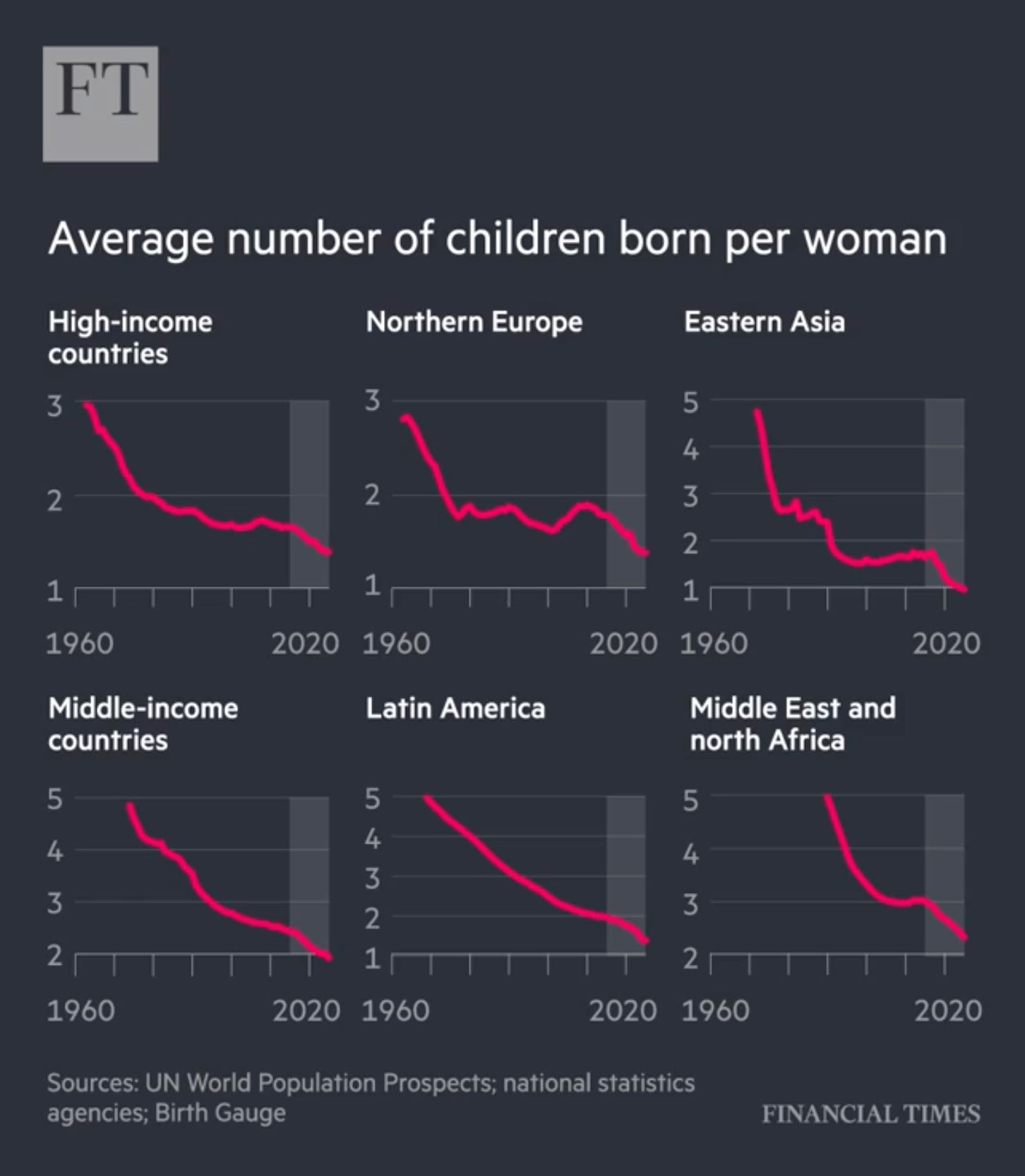
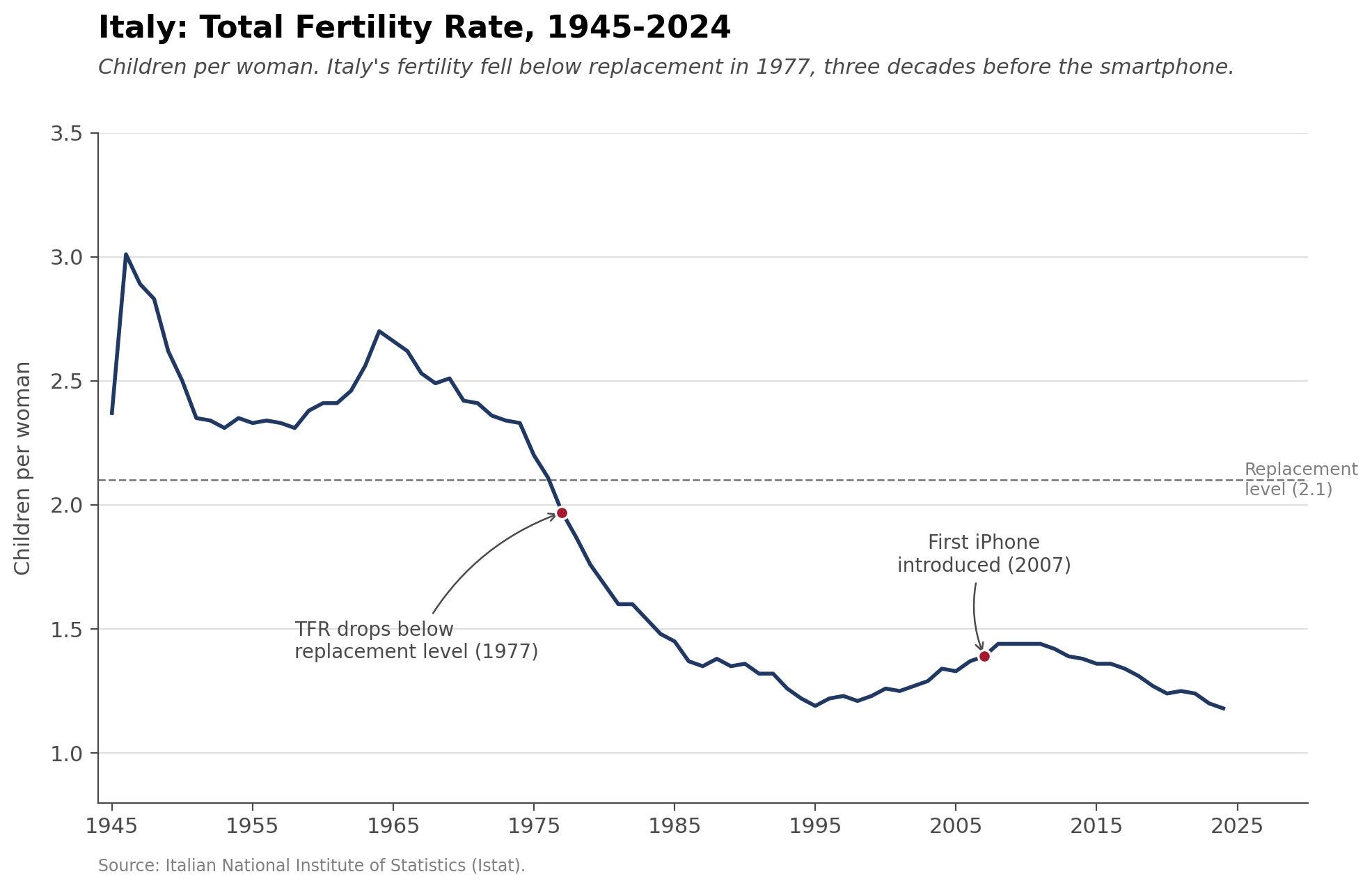
Italy fell below replacement-level fertility in 1977, three decades before the smartphone. Japan was already deep into demographic decline by the 1990s. The roots of this transformation are older than Silicon Valley’s platforms.
As economist Jesús Fernández-Villaverde (on X) argues, smartphones are probably not the only or even the fundamental cause of falling birth rates. They are an accelerator of deeper forces already at work: secularisation, urbanisation, expensive housing, weakened social networks, education pressures, changing gender dynamics, and societies increasingly organised around individual optimisation and formal systems.
The loneliness factor
Social media did not invent modernity. But they may have dramatically sped it up.
What would once have taken 25 years to spread culturally can now happen globally in less than a decade.
And the shift may not even begin with children themselves. Surveys still show many young adults want families and roughly two children. The bigger change may be happening earlier: fewer couples forming in the first place.
Less in-person socialising. More time online. More isolation. More comparison. More fragmented attention. More unrealistic expectations shaped by digital culture and algorithmic feeds.
One striking chart shared by Fernández-Villaverde helps explain how unforgiving the numbers become. Even if 90% of women have children and mothers average 2.2 children each, society still falls below replacement level. Once large numbers of people remain childless, the required average family size rises surprisingly quickly.
Which also means this may not simply be a story about “people choosing smaller families”. It may increasingly be a story about loneliness, instability, difficulty forming long-term relationships, and a generation spending less time together in the physical world.
The deeper question underneath
And the consequences go well beyond demographics.
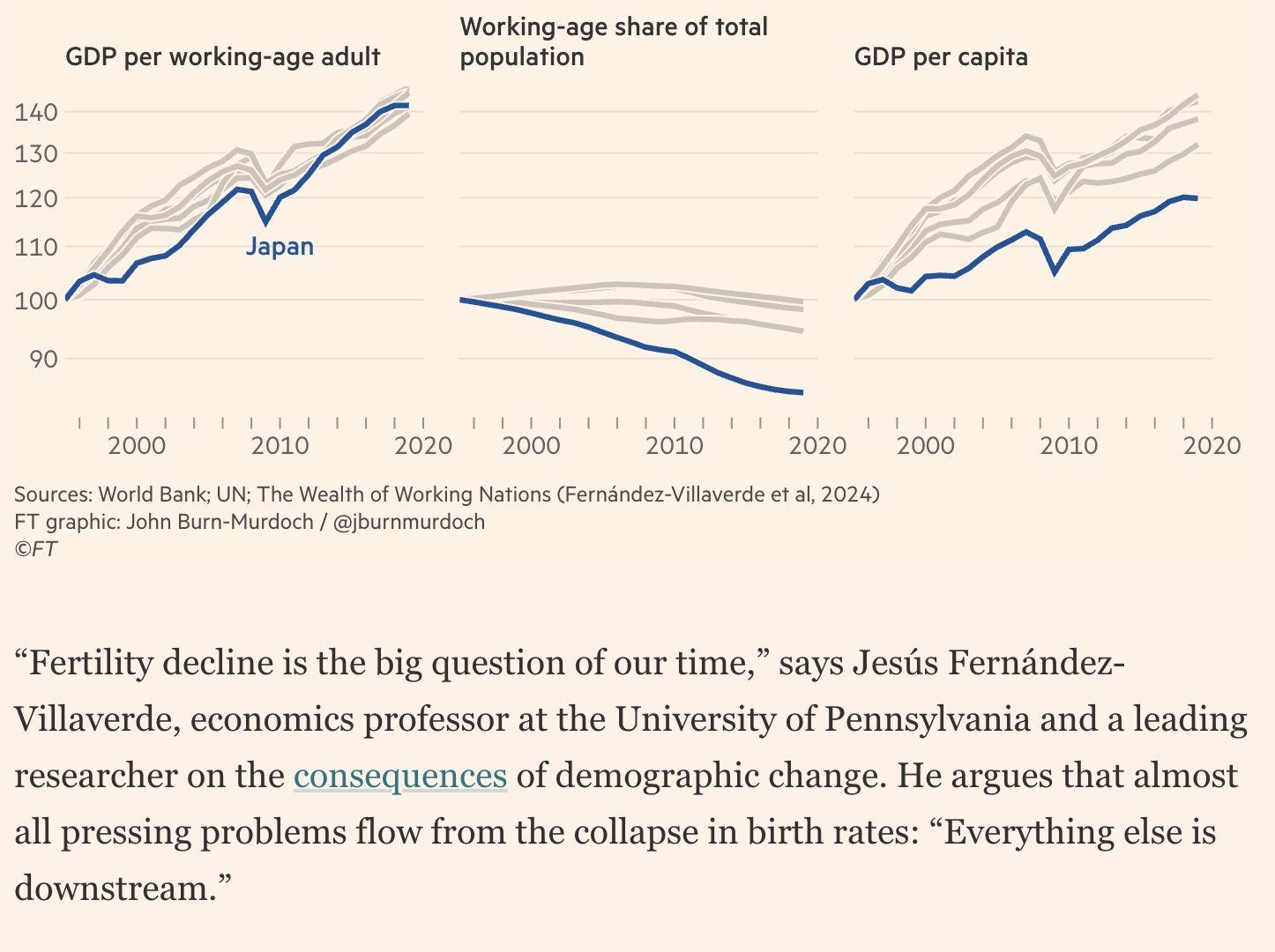
Ageing societies reshape economies, pensions, healthcare systems, housing markets, politics, immigration debates, and even the emotional atmosphere of countries. Japan is often treated as the warning sign, but versions of the same pattern are now appearing almost everywhere.
At the same time, western societies remain heavily focused on other urgent issues, often for very good reasons: economic growth, healthcare pressures, wars, political instability, and now the enormous technological shifts brought by AI.
But there is no easy policy fix for something as human and emotional as building families, feeling stable enough to have children, or simply finding meaningful connection in modern life.
One recurring conclusion I often heard while hosting Made in Tech podcast between 2020 and 2023, talking with researchers and experts on social media, mobile phones, and the attention economy, was that societies eventually adapt. Humans learn. Media literacy improves. People slowly become more aware of how technology shapes behaviour, emotions, relationships, and attention.
But that adaptation takes time.
And there are still few incentives pushing in that direction when screens, recommendation systems, and algorithms have become extraordinarily good at capturing attention and keeping us engaged for longer periods of time.
Reality is probably messier than any clean ideological explanation. Economics matter. Culture matters. Technology matters. Homes and phones can both be part of the same story.
But what makes this topic important is that it may ultimately be less about fertility itself and more about a broader question: whether modern societies are quietly becoming environments where sustained human connection, stability, and family formation are simply harder to achieve.