
Where Did the Stop Button Go? Raising a 10-Year-Old in 2026
Raising a 10-year-old in 2026 means figuring out where technology helps and where it gets in the way. Some thoughts on screens, AI, independence, and knowing when to press stop.
A weekly note about the human side of the Internet and AI, from Lisbon. (let’s see if I can keep up with this)
My son is 10 and is about to start fifth grade. That means a new school, new classmates, more teachers, more subjects, different schedules and considerably more independence.
It is a big public school, much larger than the primary school he is leaving. One thing I am already grateful for is that phones aren’t allowed.
Because one of the things I increasingly think about as a father is how to raise a child around technology that is extraordinarily good at making people want more of it.
I grew up in the 1980s and 1990s and loved television. Of course I did. There was a glowing rectangle in the living room showing cartoons, movies, football, music (Elvis, MTV, and Portuguese talent like Ana Faria, Carlos Paião, Xutos e Pontapés, Rui Veloso, etc) news and stories from places I had never seen. My parents sometimes had to tell me to switch it off.
But television had something that much of today’s technology has gradually removed: an ending. The cartoon finished. The movie finished. The football match finished. Eventually, there was nothing interesting on. You had to wait for the time of the show and, at some point, sometimes try to record on a VCR (if the thing didn’t fail you!). Also, going to the videoclub was it’s own experience of selection and excitement (and, of course, be kind, rewind).
My son Vasco is growing up with a different kind of screen.
Where did the stop button go?
YouTube doesn’t really end. Watch one video and another appears. Short-form video removes even that decision. Move your thumb a few centimetres and there’s another video waiting for you. And as we all know by know, the algorithm know what humans like, but even more so what you in particular value the most and gives you more of that.
But Roblox (the gaming already social media platform) presents a different problem in our house. Vasco loves it, although these days he can go weeks without playing. One reason we’ve reduced it is surprisingly simple: Roblox can be difficult to leave. My kid already knows that I hate it, because it’s definitely challenging making him stop — and he likes to play with his school friends on video calls over WhatsApp (fortunately that doesn’t happen for several weeks now).
Many of its popular experiences are persistent multiplayer worlds. You’re playing with other people. Something is happening, real time, “real” virtual people. Something else is about to happen. Leaving can mean abandoning whatever you and your friends are doing. “Five more minutes” (that is really one more hour) makes perfect sense to the child inside that world.
I find games with natural stopping points and the PAUSE button much easier to manage. Finish the match. Complete the level. Save the game. Stop.
This goes beyond children lacking discipline. Regulators are increasingly looking at the design itself. In February, the European Commission preliminarily found TikTok in breach of the Digital Services Act over what it called its “addictive design.” It specifically identified infinite scroll, autoplay, push notifications and highly personalised recommendations as features that can encourage compulsive use.
A television channel wanted me to keep watching too. Today’s technology companies have vastly better tools for achieving it.
Adults aren’t exactly winning this battle either.
Even Sam Altman couldn’t stop
Sam Altman told a story recently that I keep thinking about.
The OpenAI CEO started using TikTok because his company was developing Sora as a social product for AI-generated video. He wanted to understand TikTok and its recommendation system. His plan was to spend about ten minutes using it before bed.
Eventually, he found himself spending around three hours one Saturday afternoon scrolling TikTok. He compared the experience to a drug and eventually deleted the app because he found it too powerful.
There is something funny and revealing about the CEO of OpenAI deliberately studying an algorithm and still getting caught by it.
If Sam Altman needed to delete TikTok, perhaps we should cut 10-year-olds some slack. OpenAI has since discontinued the Sora social app.
The problem with measuring hours
There are reasons to worry beyond what I see at home.
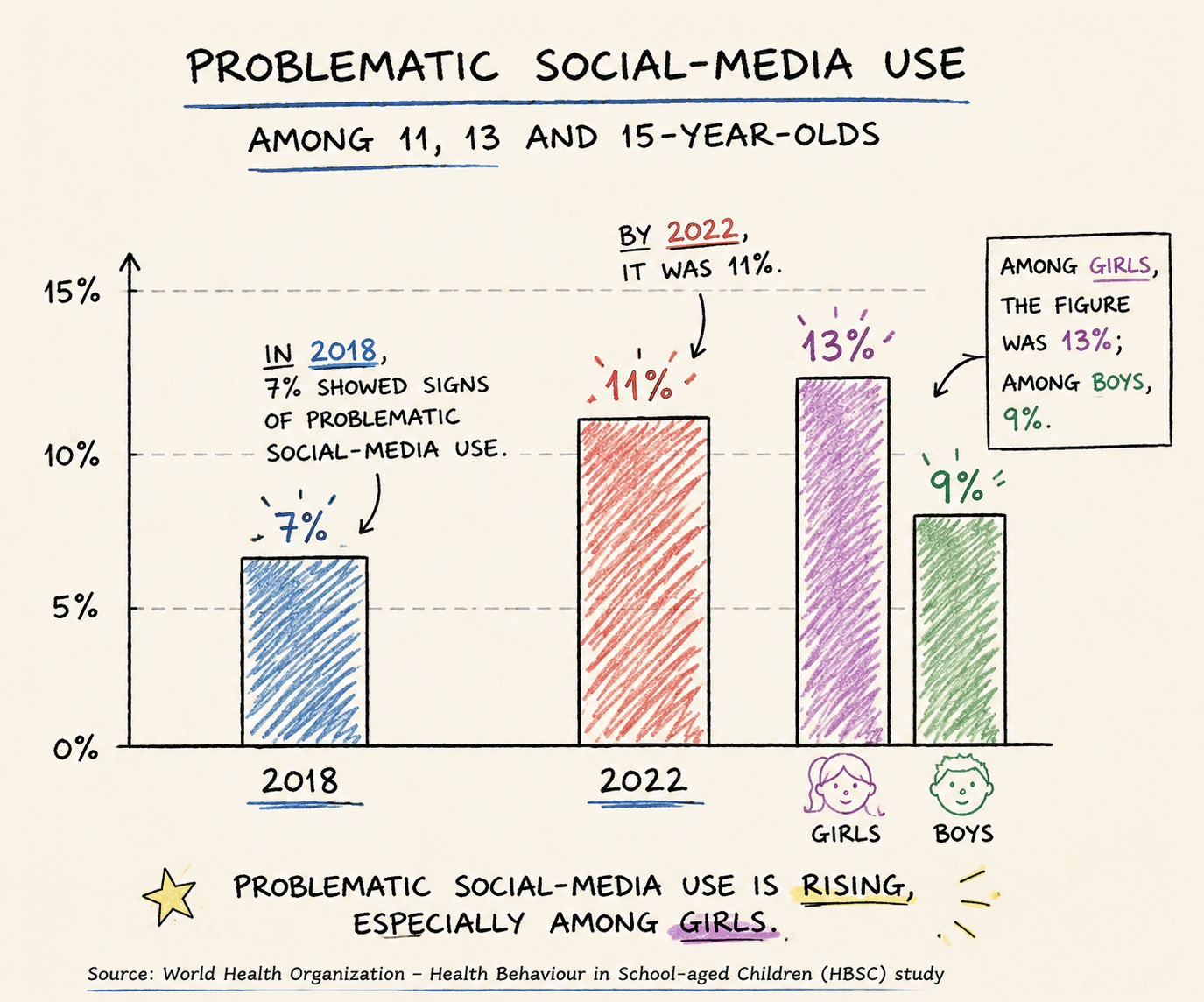
The World Health Organization studied almost 280,000 children aged 11, 13 and 15 across 44 countries and regions. In 2018, 7% showed signs of problematic social-media use. By 2022, it was 11%. Among girls, the figure was 13%; among boys, 9%.
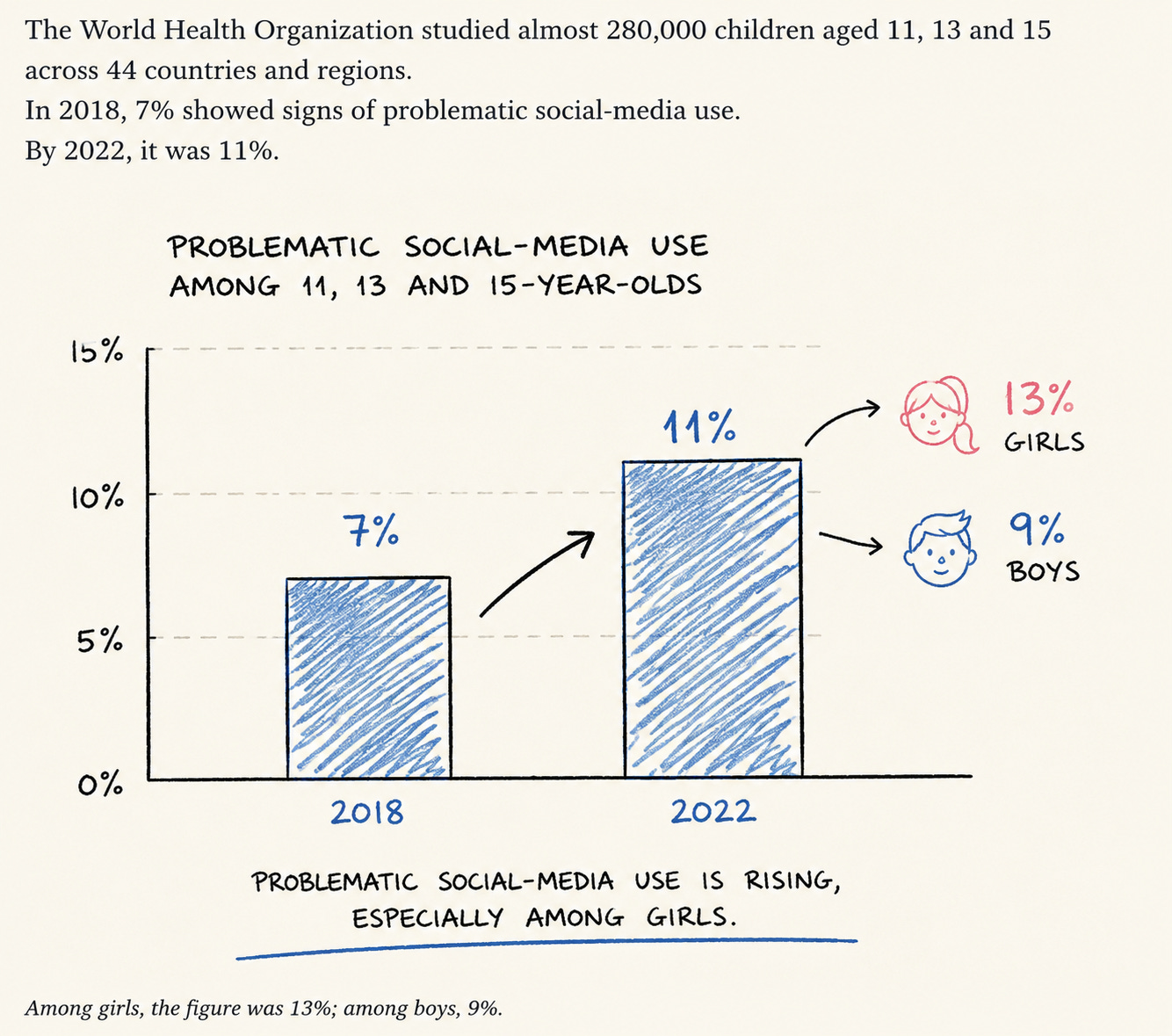
The definition matters, of course. Researchers weren’t simply counting hours. They looked for things such as difficulty controlling use, neglecting other activities, withdrawal-like symptoms and negative consequences.
That’s much closer to what concerns me with Vasco. An hour creating something on a computer has very different consequences from an hour disappearing into Shorts. Playing Minecraft with school friends is different from scrolling alone. Watching a movie with your parents is different from watching dozens of algorithmically selected videos in your bedroom.
The research also suggests a complicated relationship. A large 2025 analysis covering 117 longitudinal studies and more than 290,000 children found small effects running in both directions: more screen use predicted somewhat more later socioemotional problems, while children already experiencing socioemotional difficulties also tended to increase their screen use.
So I don’t want Vasco growing up believing that screens are simply bad. That would be a strange lesson coming from me. Technology has been an enormous part of my life and career. Computers gave me ways to write, create, learn and connect with people I would never otherwise have met.
What I want him to understand is that different technologies ask different things from him, and many of them are competing for his attention.
Three kids, three phones, zero conversation (zombies around)
The number of hours worries me less than what those hours replace.
Children need other children. They learn how people work by playing with them, negotiating rules, arguing, being included and excluded, making someone laugh, annoying someone and discovering they’ve gone too far. They gradually learn that another person can see exactly the same situation completely differently.
I remember watching the alternative on a tiny scale at Vasco’s old school. He idolised a boy who was a year older than him. The boy already had a smartphone at nine or ten and occasionally brought it to school, even though phones weren’t allowed.
One day I saw him with two other children, all around 10 years old, each holding a phone. Nobody was talking or playing. They were physically together, but each was absorbed in a different screen.
Adults do this constantly, and I’m guilty of it too. Seeing it among children felt different. Ten-year-olds should have plenty of time to be ridiculous together.
This is one part of Jonathan Haidt’s argument in The Anxious Generation that particularly resonates with me. His recommendations include more independence, free play and responsibility in the physical world, alongside delaying smartphones and social media.
And this is also where I recognise some of myself in Vasco.
He loves being at home. So did I. The difference is that I grew up with a forest around my house. The forest almost felt like another room. I could be “at home” while spending hours outside exploring and playing.
Vasco is growing up in Lisbon. Going outside means something different.
Fortunately, he loves being with other children. He gets that every day at school. During the summer he spends long days at camps, mostly without screens. He plays, swims, talks and comes home tired. I value that more as he gets older.
How much independence should a watch buy?
This brings me to a technology I’m considering buying him: a simple children’s watch that would let him call us and potentially let us see where he is.
The reasoning seems sensible. He’s changing schools. He’s getting older. He’ll gradually become more independent. A watch could give him the useful part of a phone without putting YouTube, Roblox, social media and the whole Internet in his pocket.
Haidt actually recommends basic phones or watches as an intermediate step before smartphones. I’m still unsure whether Vasco needs one.
A 10-year-old being able to call his parents whenever he wants sounds reassuring. Being able to see where he is sounds even more reassuring. Perhaps knowing his location would make us comfortable giving him more independence. Yet I also wonder whether both of us need to learn that independence includes moments when Dad doesn’t know exactly where Vasco is. Mixed feelings here.
Technology gives parents capabilities our parents never had. Deciding which capabilities to use is now part of parenting too. And I don’t have a definitive answer to me and to others.
AI can help him think. It can also become someone to talk to
Then there is AI.
Vasco already knows how to use it. Occasionally, probably less than once a week, he borrows my phone and opens an AI project I’ve created specifically for him. I’ve given the model instructions about his age and how I want it to interact with him.
Sometimes he asks questions about Harry Potter: why something happened, how some detail of the story works, whether his interpretation makes sense. He’s also writing a script and sometimes talks through ideas with the AI.
One rule I gave the model is particularly important to me: it isn’t allowed to write the script for him. Vasco has to bring the ideas. The AI can ask questions, explain things and help him develop what he has already imagined.
I like that use of AI. I can see what he’s doing, I’m usually nearby, and the machine is helping him with something he already wants to learn or create.
The relationship changes considerably when a child starts treating the machine as a confidant or companion. There have already been high-profile cases involving teenagers who died by suicide after prolonged interactions with AI chatbots, including lawsuits alleging that chatbot interactions contributed to the deaths. Those cases don’t establish a simple causal relationship between an AI conversation and suicide, but they expose a new category of risk for parents.
Vasco is still 10. By the time he is 14 or 15, we’ll have several more years of evidence about how children interact with AI, and hopefully better safeguards. I also expect the technology to become vastly more convincing.
I did several episodes of my first podcast, Made in Tech, about social media and its effects. The lesson I took from those conversations was the importance of digital literacy: understanding how these products work, how they compete for our attention and how they can affect us. Children need that literacy, but so do adults. I certainly do. After all those interviews and years spent thinking about this, I’m still kind of addicted to Twitter.
For now, I want Vasco to think of AI as a useful tool that can help him learn and create, while leaving the thinking and the human relationships to him.
Some problems are still waiting for us
AI companionship is only one of the things waiting further down the road. There is social media, pornography, dating, online status, body image and all the strange expectations the Internet can create about relationships (and the wrongs social media also brought in a wider scale).
I’m not going to pretend I have answers to parenting problems I haven’t yet had to deal with.
But I keep returning to the importance of learning how to deal with other human beings. Real people disagree with you. They get bored. They misunderstand you. They don’t always want to play the game you want to play. Eventually, the person you like might not like you back.
Children need opportunities to experience awkwardness, disagreement and rejection, and to learn what happens next. Playing with other children is an early version of that education.
Technology increasingly offers alternatives with far less friction. Pornography can distort expectations around sex. AI companions can always be available and attentive. Algorithms can become exceptionally good at supplying whatever keeps us engaged.
A child still has to learn to live among people who don’t have an engagement algorithm.
Building is becoming the easy part
Vasco is already getting a small taste of another side of AI: how easy it can make building things. We created Casa da Magia together, a Harry Potter website that started as a place to save his favourite book covers and grew through his ideas into something much bigger, with quizzes, educational games and even a Harry Potter version of the old Nokia Snake game. I did the actual building with AI, while Vasco became a kind of 10-year-old product manager: deciding what he wanted, testing things, giving me pointers and coming back with new ideas. He now understands that an idea for a website or a little product doesn’t have to remain an idea for very long.
This connects with something I heard Peter Steinberger, the creator of OpenClaw, discuss this week in his Y Combinator talk, “What Happens When 4.7 Million People Let It Cook”. As AI makes building dramatically easier, the scarce parts move elsewhere: having a reason to build something, making something people actually want, and finding a way to distribute it.
That’s something I’d like Vasco to learn from AI too. For now, his experience with building is limited to our projects together and some occasional Minecraft and Scratch at school. Being able to build almost anything is powerful. Figuring out what is worth building, why you’re building it, and how to get it in front of people will increasingly be the harder part.
Eventually, I won’t be setting the controls
I don’t have a grand solution. Vasco is 10, and me and my wife are figuring this out as he grows.
But I’m starting to have some rules of thumb. I pay attention to whether a technology has a natural stopping point and what the screen is replacing. Creating something matters differently to me than consuming an endless feed. I want him spending large amounts of time with other children without devices mediating the interaction.
I’m delaying the smartphone. I’m still deciding about the watch. With AI, I’m trying to show him how it can be useful while keeping it close enough that I understand what he’s doing.
Most importantly, I want to understand the products he uses rather than simply telling him they’re bad. He’s going to grow up in a world filled with AI, algorithms and screens. Banning everything until he’s 18 would teach him very little about how to live in that world.
For now, I can set limits on Roblox. I can keep the phone away. I can configure his AI project. I can choose whether he gets that watch.
Eventually, I won’t be setting the parental controls.
He’ll need to know when to press stop himself.
PS: Dad was more excited about the eclipse
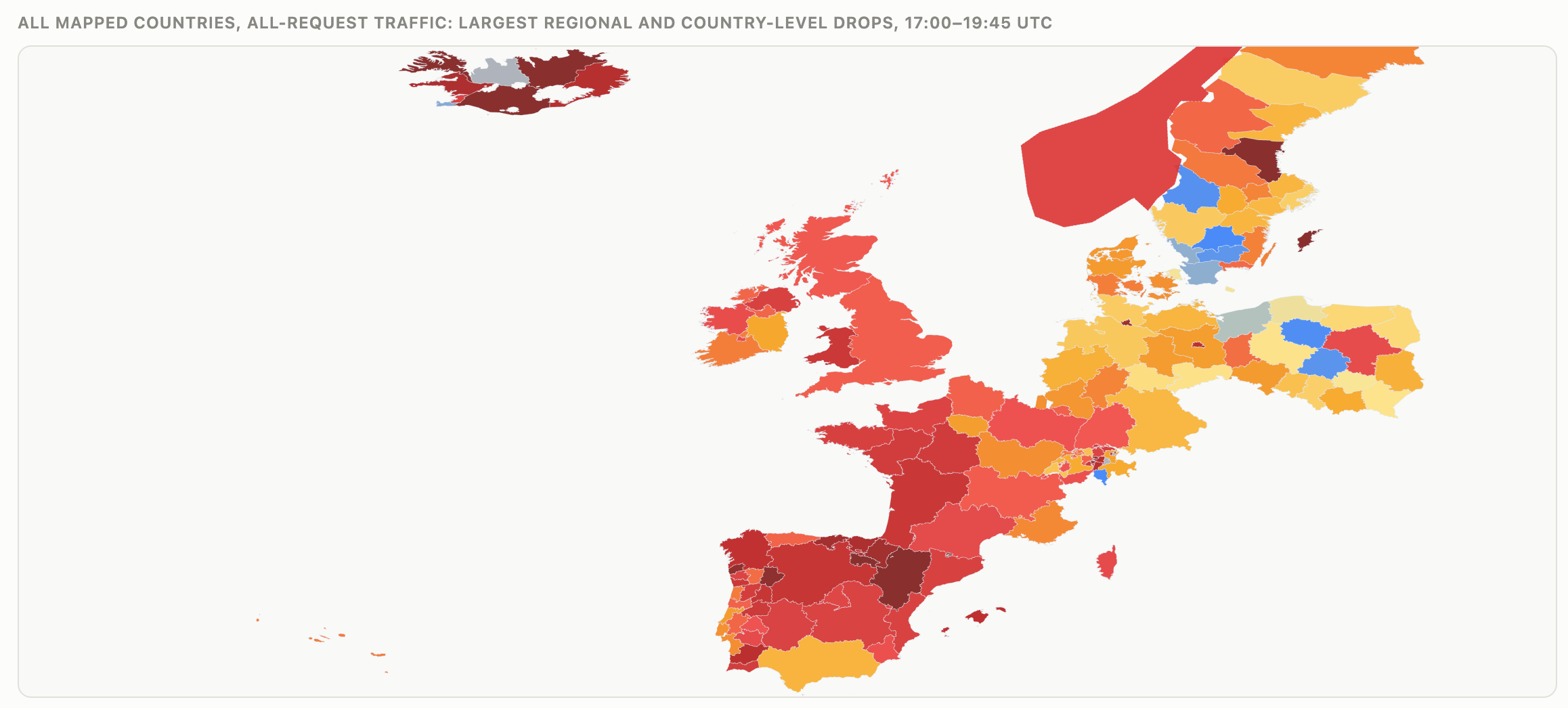
There was a solar eclipse over Europe this week, and I took Vasco and my wife to a park near our home in Benfica to watch it. I also built a dashboard showing how Internet traffic changed during the eclipse: country-level traffic fell as much as 23% in Spain, 22% in Iceland and 17% in Portugal, with much larger drops in some regions.
I was considerably more excited than my 10-year-old.
Through the eclipse glasses, the Sun looked extraordinary. The Moon covered most of it, leaving only part of the Sun visible. What surprised me was how much light remained. The park became dimmer and the light looked strange, but it wasn’t remotely dark.
A tiny exposed portion of the Sun is still incredibly bright. Totality is a completely different experience, which I hope we’ll get to see together someday.
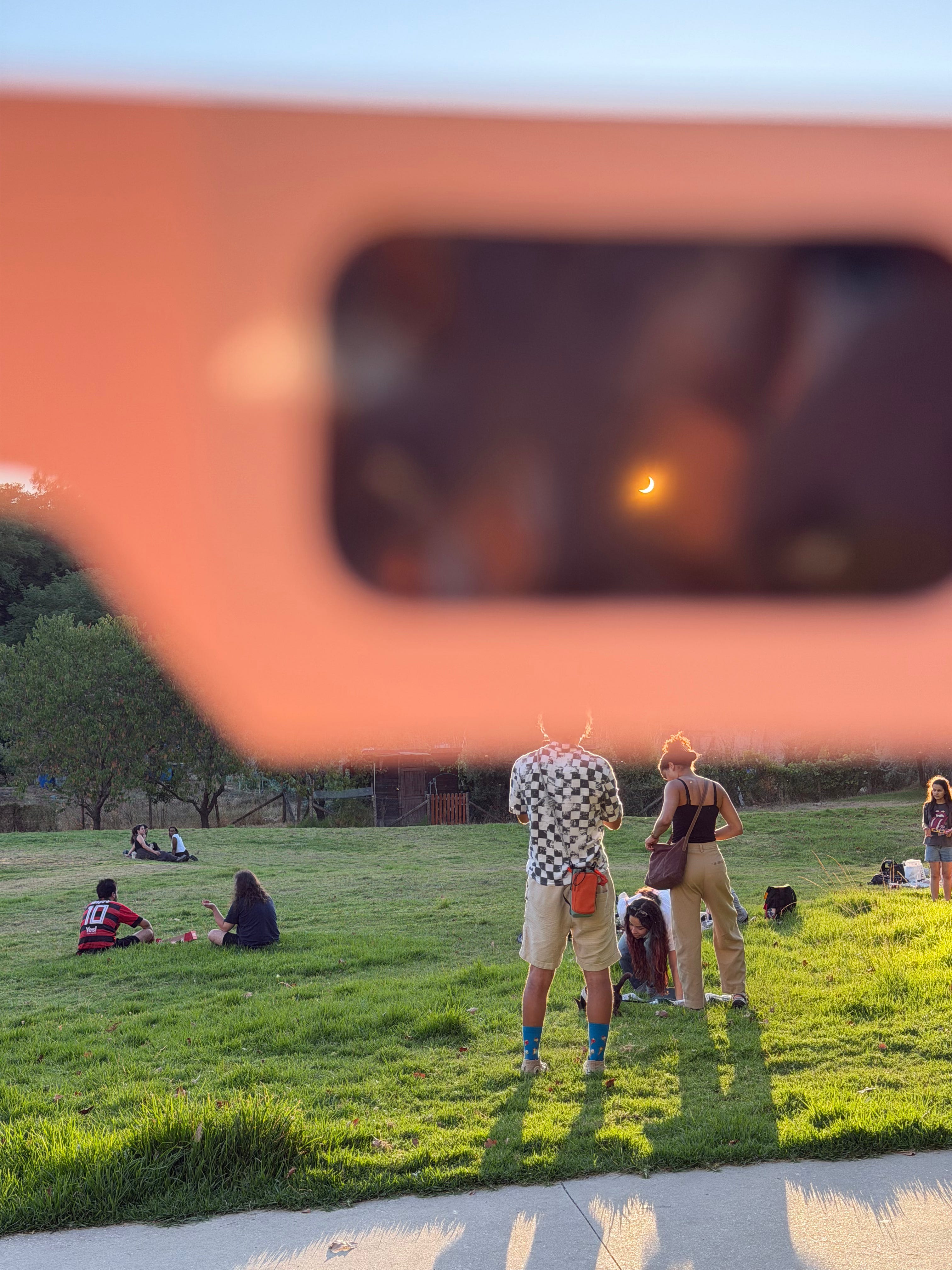
Perhaps Vasco would have been more impressed by 100%. Or perhaps eclipses simply aren’t his thing.
That’s another lesson children teach you. You can show them the books you love, the movies you love, the games you love, the places you love and a sky you find extraordinary. Then they decide for themselves what they find interesting.
Annoying, really.


Things I read, noticed or saved this week
Our Last Wi-Fi-Less Refuge Is Gone. Subpar airplane connectivity gave us a few hours when being offline was normal.
OpenAI and Anthropic’s AI price war. Model pricing is falling as competition increases and Chinese AI companies gain ground.
Gemini 3.7 Flash and DeepSeek Harness. Two AI releases that got attention this week.
Cerebras brings ultrafast inference to GPT-5.6 Sol. Cerebras on accelerating inference for OpenAI’s GPT-5.6 Sol.
Mistral expands European infrastructure for sovereign AI. In-region inference, open models and additional European compute infrastructure. Also: Mistral OCR 4.1.
Reddit is joining the S&P 500. Reddit’s addition to the index and some of the concerns analysts still have about the company.
How Organizations Use AI: Evidence from ChatGPT. OpenAI research on how organisations are using ChatGPT. There’s also a Hacker News discussion.
Blog about things you don’t understand yet. Sean Goedecke on using writing to investigate subjects you haven’t figured out yet.
Terabytes of credentials leaked in a massive supply-chain attack. A supply-chain compromise and the credentials exposed through it.
Where did the old web go? We followed 657,607 links to find out. An analysis of 657,607 links looking at link rot and how much content from the older web remains accessible.
The global submarine-cable network can now detect whales, even when they’re silent. How submarine fiber-optic cables can be used to detect whales and track their movements.
Peter Steinberger: What Happens When 4.7 Million People Let It Cook. A Y Combinator talk with Peter Steinberger about building OpenClaw and its growth.
This entrepreneur will pay you to provide home care for your loved ones. Abby Care founder Havi Nguyen is building a service that helps family members become paid caregivers through Medicaid programmes.
Water system controllers don’t belong on the Internet, says ex-NSA chief. Former NSA director Rob Joyce argues that water-system industrial controllers shouldn’t be directly exposed to the Internet.
AI Coding and Mental Health. Scott Tolinski looks at positive and negative mental-health effects of AI-assisted coding using survey data and expert commentary. The survey data is here.
Learned a lot with this video from Riley Brown.
