
What I Learned Analyzing 1,248 Players at the 2026 World Cup
I built a dashboard for the 2026 World Cup. It tracks 1,248 players across 48 squads (ages, heights, market values, club pipelines, historical trends). What the numbers reveal about modern football.
Dashboard for this (with Claude Code + Codex help for the python charts): worldcup-2026-dashboard.pages.dev/.
The 2026 World Cup features 1,248 players from 48 countries. Some are old enough to have debuted professionally before Facebook, Instagram or TikTok existed (or smartphones, for that matter). Others were born after Cristiano Ronaldo played his first World Cup in 2006 (and are now in the same squad as him). For the first time in history, three players will appear at their sixth World Cup. The average player is nearly nine centimetres taller than in 1930, with no sign of stopping.
Nearly €20 billion in combined squad value. More than double the total from 2018 — and about €5 billion more than 2022, even though 16 of the 48 squads are first-timers or long-absent at this level.
The numbers also say something about who wins. The last ten World Cup champions averaged 26.91 years old. Spain (at 26.19) are the only major contender younger than that historical line — I know, numbers aren’t everything, but worth taking a look at this stage. Argentina and Brazil are both averaging over 28.6. They are chasing history against the data.
I built a dashboard to explore every squad, every player, and every trend behind the tournament. Before a ball is kicked, here is what it shows.
Players have never been taller
The average player at the 2026 World Cup stands 182.76 cm. In 1930, when the tournament began, that average was 173.9 cm. Nearly nine centimetres of growth in under a century.
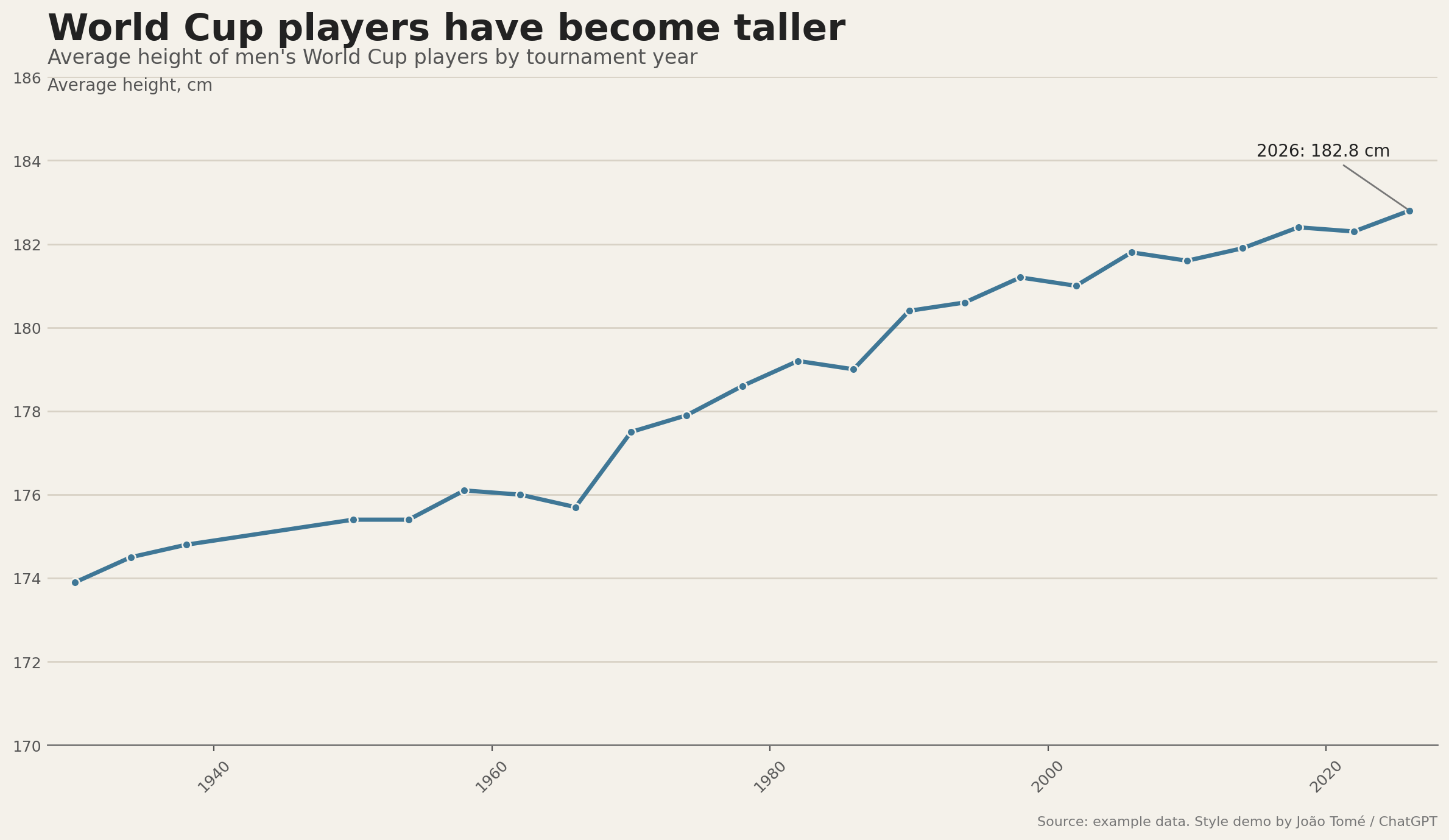
The trend is unbroken. No plateau, no reversal. Every decade, players are a little taller than the one before. It seems to reflect nutrition, sports science, and the talent identification systems that now find and develop physically imposing athletes from childhood.
Bosnia and Herzegovina arrive as the tallest squad in the field. Group B is the most physically imposing group on average. UEFA (the European confederation), unsurprisingly, sits at the tall end of the 2026 confederation rankings.
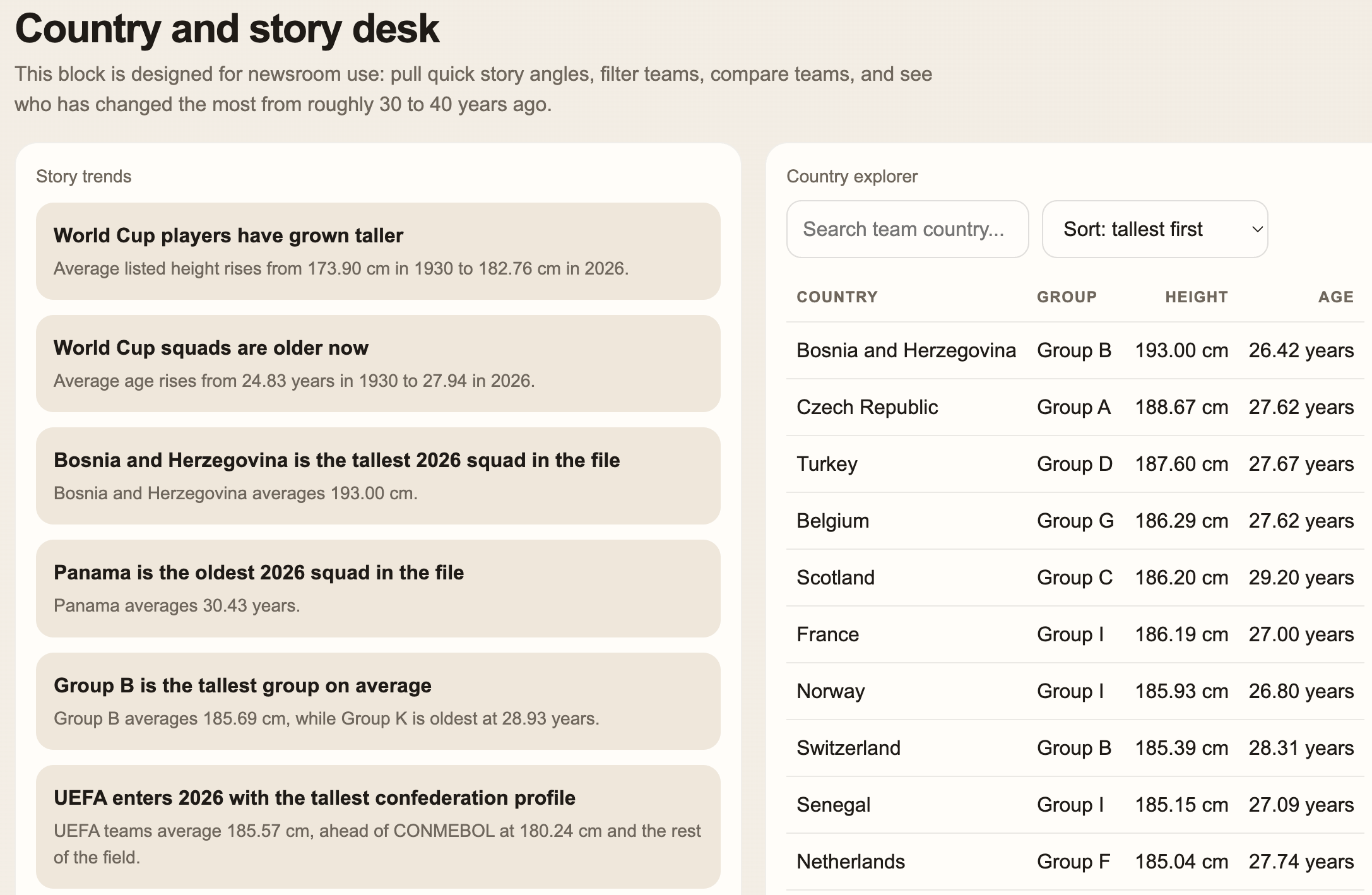
(Luis Batalha also did more more analysis on X/Twitter, including how many World Cup winners are still alive today — the oldest won in 1958)
One World Cup, two generations
Scotland goalkeeper Craig Gordon is 43 years old. Mexico midfielder Gilberto Mora is 17.
They are both at this World Cup. Twenty-six years separate them (the largest age gap between any two players at the tournament). Gordon made his Scotland debut in May 2004. Mora was not yet born.
That gap is not an outlier. It is a feature of this edition (the one with more national squads than ever). There are eight players over 40 at the 2026 World Cup. A record. There are 22 players under 20. Mexico fields both its oldest and one of its youngest players at the same tournament, bridging a 23-year range within a single squad.
Then there are Lionel Messi (38 — turning 39 on June 24, during the group stage!), Cristiano Ronaldo (41), and Mexican goalkeeper Guillermo Ochoa (40). Those are the first players in history to appear at six men’s World Cups. Six tournaments span 1998 to 2026. That is 28 years of the same players showing up. Most of the teenagers at this World Cup were not alive for their first one.
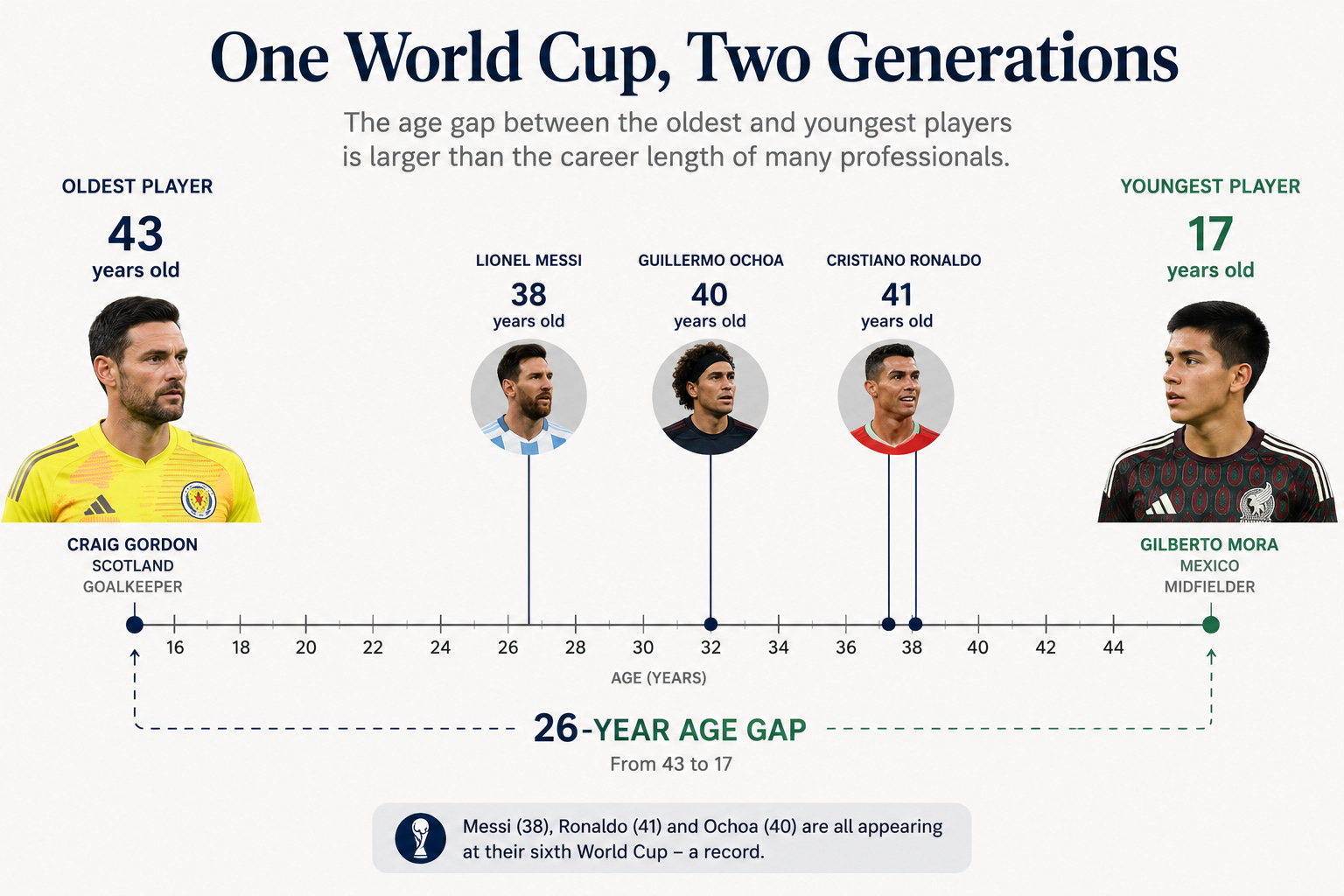
The overall squad average of 27.94 years (older than 2022, effectively tied with the modern peak in 2018) captures the trend. But averages miss what Craig Gordon and Gilberto Mora make visible: this tournament contains multitudes.
Squads have never been older (and history has a warning)
Panama bring the oldest squad at an average of 30 years. Ivory Coast bring the youngest, at 25.35.
The data from the last ten World Cup winners is worth taking a closer look. Their average age was 26.91. That’s younger than the 2026 field average of 27.94. Italy won in 2006 at 28.80, the oldest in that window. Spain won in 2010 at 25.00, the youngest. The middle holds: experienced-but-not-ancient cores tend to win.
The four teams making their first-ever World Cup appearance — Cape Verde, Curaçao, Jordan, and Uzbekistan — all arrive with older-than-average squads. New qualifiers tend to rely on their most experienced generation to get there.
Nearly €20 billion of squad value (the gap is growing)
The combined squad value across all 48 teams at the 2026 World Cup is approximately €19–20 billion. To put that in context:
In 2018, Brazil topped the field at €673 million. England were valued at around €279 million. The total across all 32 squads was roughly €7–8 billion.
By 2022, the field had inflated dramatically. England led at €1.5 billion. The total across 32 squads reached approximately €15 billion — nearly double 2018 in four years, driven by player value inflation in the post-pandemic transfer market.
In 2026, France lead at €1.52 billion, England at €1.36 billion, Spain at €1.22 billion. The total has reached approximately €19–20 billion (but this time across 48 teams). The per-squad average actually fell slightly: from roughly €469 million per team in 2022 to around €400 million in 2026. The 16 new squads (Cape Verde, Curaçao, Jordan, Uzbekistan and others) bring real talent but lower valuations.
The result is a more unequal tournament in value terms than any before it. The top five squads by value (France, England, Spain, Portugal, Germany) account for over a quarter of the entire field’s combined worth. Jordan, the lowest-valued squad, is listed at roughly €17 million (about 1% of France’s squad).
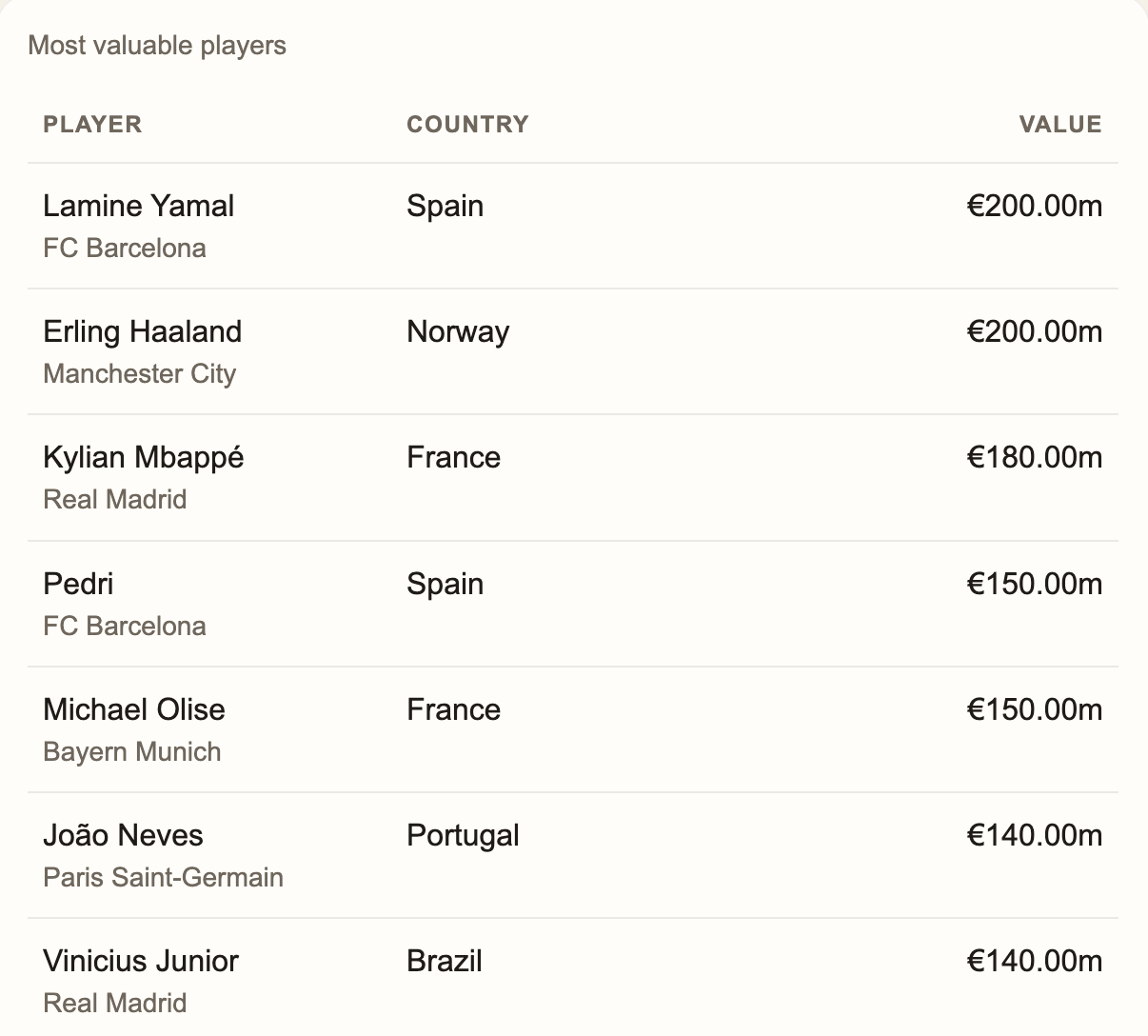
At the individual level: Lamine Yamal and Erling Haaland are both valued at €200 million each. At the other end, Craig Gordon — the 43-year-old appearing at his sixth World Cup — is listed at €50,000. So is Tyrick Bodak of Curaçao, who is 24. One is at the end of a long career. The other is just starting. The market values them identically. It takes 8,000 of either to equal one Lamine Yamal.
Premier League: England’s clubs dominate the supply chain
Which country’s clubs send the most players to the 2026 World Cup? England (and by a margin that is hard to overstate).
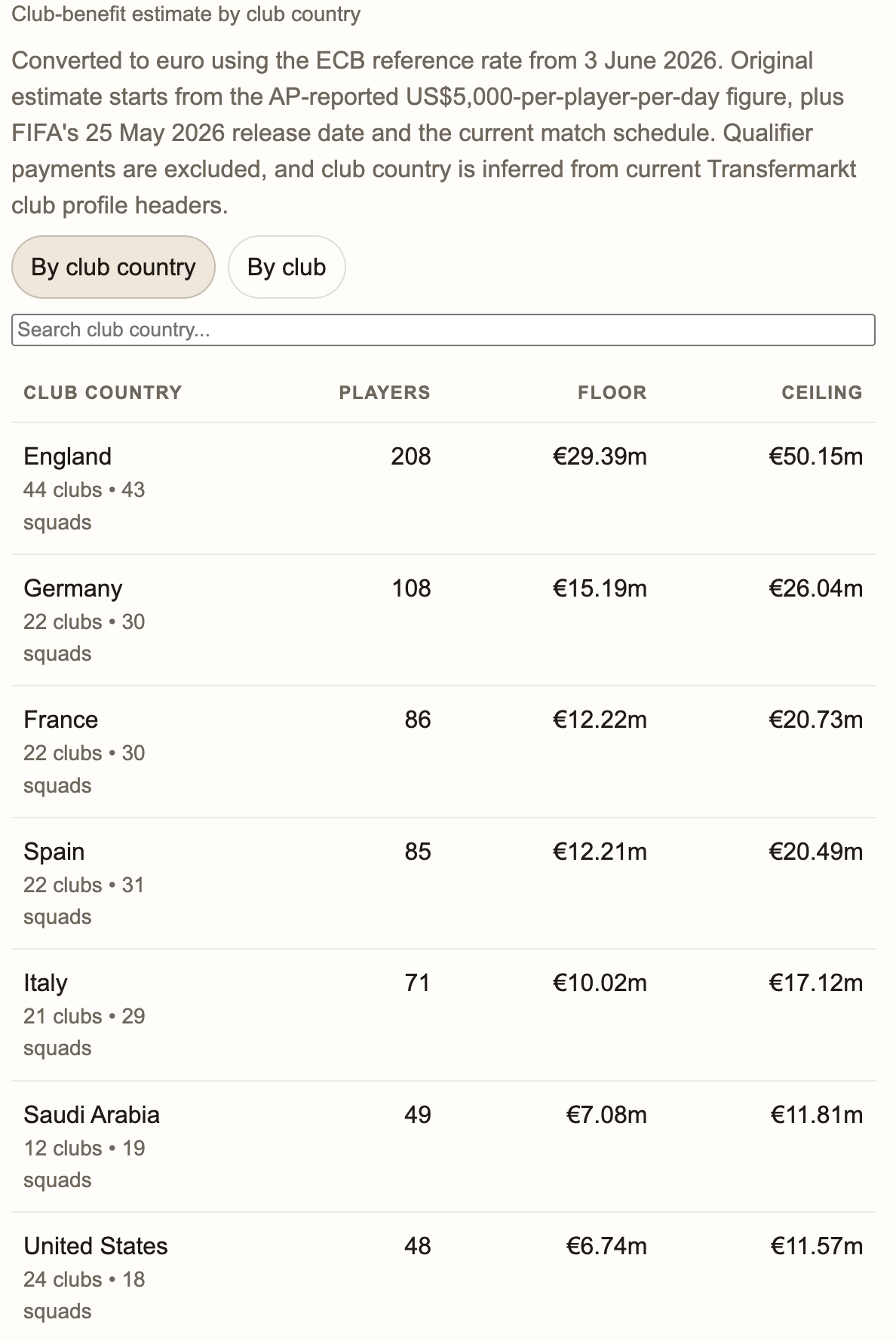
205 players play their club football in England, across 44 clubs and 43 national squads. That is nearly twice the number from Germany (108), and more than France (86) and Spain (85) combined. More than 16% of every player at this World Cup plays in England somewhere in the pyramid.
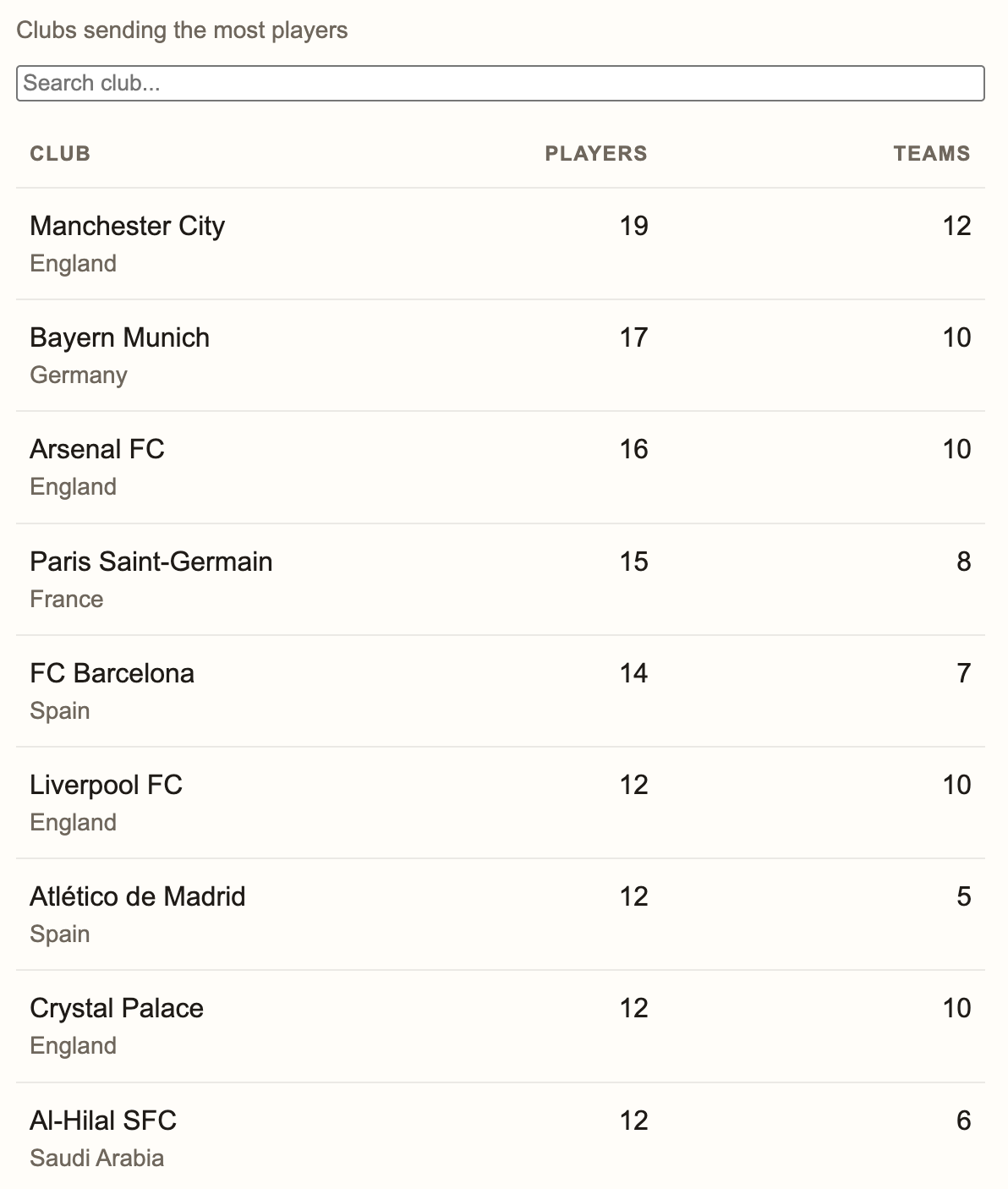
The top clubs by players released: Manchester City (19 players, across 12 national teams), Bayern Munich (18, across 10), Arsenal (16, across 10), PSG (15), Barcelona (14).
One detail stands out: Crystal Palace are sending 12 players to 10 different national teams. That is as many as Atlético de Madrid, and more than Liverpool or Manchester United (two clubs with budgets many times larger). Palace’s global talent reach in 2026 is, on this metric, genuinely elite.
English clubs also stand to receive the most FIFA compensation for releasing players: an estimated ceiling of €49.4 million across 205 players, nearly double Germany’s €26 million.
Saudi Arabia now supplies more players than Brazil
Here is the number that will surprise most people: Saudi Arabian clubs are supplying 49 players to the 2026 World Cup, across 19 national squads (some veterans, but definitely somewhat young talent as well). That puts the Saudi Pro League sixth in the world for players supplied, above the United States (48 players), Turkey (45), the Netherlands (38), and Brazil (32).
In 2018, Saudi Arabia contributed a handful of players, almost exclusively to the Saudi national team. In 2022, the league began attracting mid-career European talent at scale. In 2026, that supply is spread across 19 national squads from six continents. Al-Hilal alone is sending 12 players to six different countries, more than Borussia Dortmund (11), Liverpool (11), or Manchester United (11).
This is not the Ronaldo effect. Ronaldo arrived in January 2023; the structural shift in Saudi football’s global pipeline was already underway. The league’s model — high wages offered to players aged 27–33, early enough in their career to still be active internationals — means the Saudi Pro League is now feeding talent back into international tournaments rather than simply absorbing retired stars.
In 2018, the top player-supplying nations outside Europe were Brazil (~55), Argentina (~35), and Mexico (~20). By 2026, Saudi Arabia has overtaken all three. The table of football’s most influential club countries now includes a nation whose top league barely registered a decade ago.
MLS is no longer a retirement league
In 1994, the World Cup came to the United States. Major League Soccer did not exist yet (it was created partly to justify hosting the tournament).
In 2026, MLS is sending a record 44 active players to the tournament, up from 36 in 2022, 23 in 2018, and roughly 16 in 2010. These are not players filling out rosters. The captains of Argentina, Colombia, and South Korea all play in MLS. The league is represented in 11 of the tournament’s 12 groups, across 17 nations and 21 clubs.
103 players at this World Cup have spent part of their career in MLS. Of those, 42 came through MLS academies. The league is not just a destination for established talent (it is producing players who reach football’s biggest stages).
Thirty-two years after MLS was invented partly to justify hosting a tournament, it has become one of the world’s more significant football pipelines. The 1994 World Cup gave MLS a reason to exist. The 2026 World Cup will show what it has built.
The coaches are a story too
Germany’s Julian Nagelsmann, at 38, is the youngest head coach in the field. Six teams are coached by Argentines (including the United States, the only non-South American nation with an Argentine head coach).
Portuguese veteran Carlos Queiroz, coaching Ghana, becomes only the second person in history to manage at five consecutive World Cups, after Bora Milutinović (1986–2002).
One more: the tactical shape of the tournament has changed as well. The old forward-heavy World Cup is gone. Position share data shows a clear drift toward midfield-heavy, defensively structured squads over the last two decades. The game has reorganised itself.
What the data says about the favourites
Market value is the obvious first lens. By squad value, the order is: France (€1,523m), England (€1,363m), Spain (€1,223m), Portugal (€1,006m), Germany (€979m), Brazil (€923m). Those six squads account for more than a quarter of the tournament’s total combined worth. Portugal — my country, 10 million people — sit fourth on that list, ahead of Germany and Brazil. That number alone tells you something about what Portuguese football has built over the last decade.
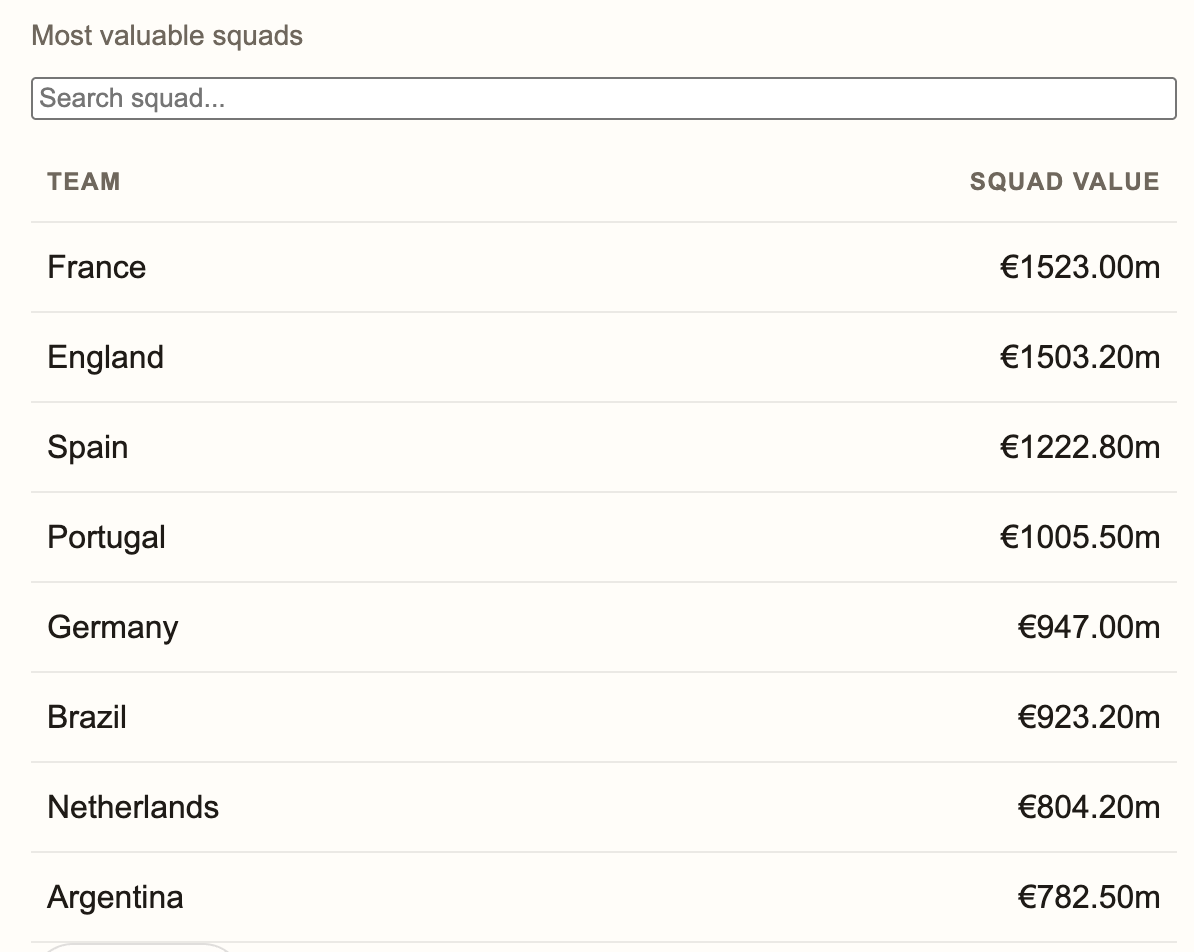
But value alone has never predicted winners (that’s why football — soccer for you Americans — is so unpredictable and loved). Argentina won in 2022 with a squad that would rank 8th by value in the 2026 field. The more predictive variable, based on the last ten champions, is age.
The historical winner average is 26.91 years. Cross that against the 2026 contenders and a clear pattern emerges.
Spain (26.19) are the youngest of the serious contenders — and the reigning European champions. Lamine Yamal at €200m, Pedri at €150m. A squad simultaneously among the most talented and the youngest in the field. By the age metric alone, they are the most structurally positioned team at this tournament. They will still be here in 2030. The question is whether they win now.
France (~26.5) combine youth with the deepest squad at the tournament. Mbappé leads, Olise and Dembélé support, and Deschamps has won this before — as a player in 1998, as a manager in 2018. He knows what the final weeks feel like. France’s historical weakness is complacency when ahead. Their strength is that they can win ugly.
England (~27.2) enter under Thomas Tuchel in what feels like a genuine inflection point. Kane, Bellingham, and Rice are all at or near their peaks. No other team has been backed more heavily by bettors. That public weight cuts both ways: it reflects real belief, and it creates real pressure on a squad that has historically underperformed it.
Germany (~27.1) are the quiet contender. Nagelsmann at 38 is the youngest coach in the field. The squad is rebuilt — younger and more cohesive than the aging group that exited in the group stage in 2018 and 2022. Worth watching.
Argentina (28.62) are running it back (17 of the 2022 champions returned, including Messi at 38 (almost 39) and Otamendi at the same age). The squad cohesion is real. So is the age. At 28.62, they are among the oldest of the main contenders, and the historical data is clear: no World Cup winner in the modern era has averaged that old. They are chasing history against the data. Messi may not care.
Brazil (28.65) are the most structurally compromised of the major favorites. The oldest contender by average age, with a defensive core — Casemiro (34), Alisson (33) — that is clearly in its final cycle. Carlo Ancelotti adds enormous prestige. Vinicius Junior (25) and teenage forward Endrick are the bridge to the future. But this squad is betting that veteran experience outweighs what the numbers say about age and tournament endurance over seven matches in five weeks.
The data doesn’t pick a winner. But it does suggest: Spain and France are built for this moment and the next one. Argentina and Brazil are built for this moment only.
A note on Portugal — this one is personal
I am Portuguese. I should be more specific about what that means for how I watch this tournament.
Portugal’s best World Cup finish is third place. In 1966. That was 60 years ago, in England, led by Eusébio. Every tournament since has carried the weight of that single semifinal, never matched, never exceeded.
This Portugal squad is, by market value, the fourth most valuable in the tournament at €1 billion. João Neves and Vitinha (both under 25, both Portuguese, both at PSG, consecutive Champions League winners!) are two of the ten most valuable players in the entire field at €140m each. Lamine Yamal and Haaland top the individual list. Portugal have the next tier covered.
The squad structure tells a story about a transition happening in real time. Ronaldo at 41 is the captain and emotional anchor (the oldest outfield player at the entire tournament). Around him: Francisco Conceição (23), João Neves (21), Nuno Mendes (23), Gonçalo Ramos (24). The genuine future of Portuguese football, already fully formed, surrounding a man who has been doing this since 2006.
João Neves was three years old when Ronaldo played his first World Cup. They are now in the same squad, building toward the same prize.
There is also a squad place dedicated to Diogo Jota, who died at 28 (a Liverpool player, killed in a car accident during the qualification campaign in 2025). That weight travels with the squad whether it is acknowledged publicly or not.
Ronaldo is chasing records that may never be broken: if he scores, he becomes the first player to score at six different World Cups, and the second-oldest scorer in tournament history behind Roger Milla (42 years, 39 days). He has scored at all five tournaments he has appeared in. Portugal have never played a competitive match against any of their Group K opponents (DR Congo, Uzbekistan, Colombia. Every fixture is new territory).
The data case for Portugal is real. The age profile sits close to the historical winner average. The squad value is elite. Two of their players are in the ten most valuable at the tournament. They are reigning Nations League champions, ranked fifth in the world.
The case against Portugal is also real. The tournament has always asked something of this squad that the talent alone could not answer (great generations of players have failed before). Roberto Martínez, now Portugal’s coach, spent years with a genuinely gifted Belgium generation and never got them to a final. That history travels with him too.
But then again: as we Portuguese know well, data and talent isn’t everything. Euro 2016 is the proof. Fernando Santos built something that had less to do with squad value or age averages and more to do with belief (a collective conviction that something was possible that the numbers wouldn’t have predicted). Portugal barely scraped through the group stage and won the whole thing (it was the opposite during the Euro 2004, a final lost to less favourite Greece). Sometimes the internal (in the squad) vibe matters more than the data. Whether that changes in 2026 is the question.
The data is there to understand the structure of the tournament (the flows of money and talent, the patterns that predict outcomes). It does not resolve the part that makes football worth watching. The part where the data runs out and something else takes over.
Every four years I tell myself I won’t care as much this time. It never lasts past the first match. I will be nervous. That is the point.
Where this data comes from
I am a former journalist. I work with Internet data professionally and have spent the last few years close enough to engineers and data scientists to start building my own notebooks. This dashboard took 4 days to build. It is not perfect, and I will keep updating it as the tournament unfolds.
Everything in this piece is drawn from the World Cup 2026 Dashboard (a project I built for me… and for fans and journalists covering the tournament). It combines the Luis Batalha historical dataset (squad height and age going back to 1930 available on GitHub — thanks Luis!) with current Transfermarkt squad pages for market values and club pipelines. Additional context from CBS Sports, RotoWire, Goal.com, Flashscore, Al Jazeera, and FIFA official squad lists published in June 2026.
The dashboard is designed for newsroom use (former journalist habits die hard). Quick story angles, group comparisons, country-by-country explorer, live match readiness once the tournament begins. If you cover football, or just follow it closely, it is worth a look. And send suggestions and corrections!
The tournament starts June 11 (this Thursday)! I will be watching, as I always do, as a Portuguese person who grew up caring about this too much. The data helps me understand what I am seeing. It does not make it less nerve-wracking.
All squad-level data from worldcup-2026-dashboard.pages.dev
· Luis Batalha historical dataset · Transfermarkt squad pages, June 2026 · CBS Sports · RotoWire · Goal.com · Flashscore · Al Jazeera · FIFA official squad lists